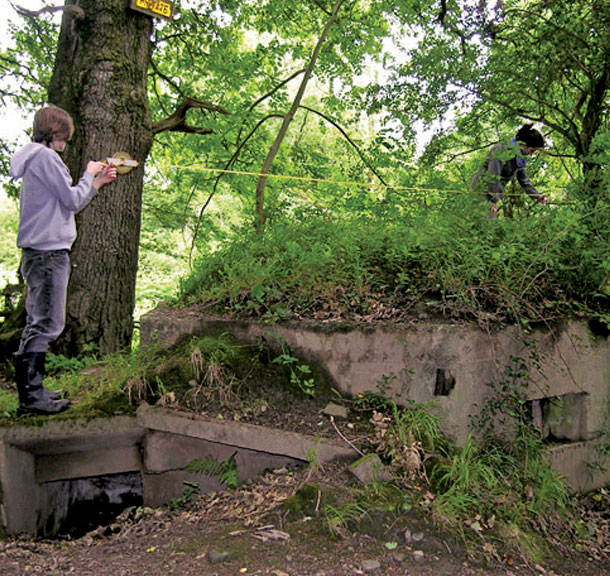
Aqueduct LB16143 a Grade II listed structure was crane-lifted by King Lifting under the supervision of GGAT Projects staff on 22nd October 2008; to enable the structure to be conserved and reconstructed by a specialist company.
The aqueduct was constructed in c1876 to carry one of the leats that form part of the Dowlais Free Drainage system, (a series of leats and reservoirs designed to carry water from Cwmbargoed Mountain to the Dowlais Ironworks), across the Taff Bargoed branch of the joint Rhymney and Great Western Railway. The sides and base of the aqueduct were constructed from long planks held in place by timber cross members above and below them, tied vertically with iron rods. Before the structure had been recorded by GGAT it had been suggested that water trough might once have had a lead lining, however GGAT discovered it was actually lined with a coarsely woven fabric. The entire structure was approximately 32m in length and supported on three timber trestle piers, which rested on two masonry and brick abutments and a wooden abutment. It is believed that the aqueduct was last rebuilt during the 1960s.
The gale force winds of January 2007 caused the entire structure to collapse into the base of the cut where it broke into several individual elements. Subsequently GGAT was hired to archaeologically record the structure prior to its conservation. Each of the timbers used to construct the aqueduct was uniquely numbered, photographed, drawn and a written record created for it. On completion of the recording process each individual element was lifted out of the cut in its entirety, apart from the southern most section of the aqueduct, which had to be cut into two sections to enable safe lifting. Each of these sections where then secured to specifically created pallets for transportation to the conservation company's offices in Wakefield.
GGAT pioneer new survey technique at Ffos-Y-Fran Site
One of the structures investigated as part of the Ffos-y-fran Land reclamation scheme was a tramroad/railway at the point in which it had been spanned by an over-bridge. Due to the size and complexity of the structure it was decided to record using the latest laser scanning technologies. Total Surveys Ltd were commissioned to carryout the survey, which produced a fully integrated and interrogable 3D model of the overbridge to an accuracy of 6mm.
GGAT and Miller Argent (South Wales)are among the first companies in the UK to pioneer this type of technology for use in archaeological recording.
At this point the tramroad ran between two battered walls of rusticated sandstone ashlar, which funneled into what we think wes the site of the original overbridge and then funneled out again. These walls were raised in height at least once, probably when the line was converted to standard gauge,which is known to have occurred from the late 19th-and-early 20th centuries (OS 1st to 4th edition maps c1880–1920). No evidence for the over-bridge survives.
The original tramroad surface was identified beneath 2.5m of made ground, the latter presumably laid down for the conversion to standard gauge, and it is likely that the over-bridge was removed at this time. The over-bridge is thought to have served a ‘squatter settlement ’, which was possibly providing labour to the fledgling Dowlais Ironworks, Merthyr Tydfil, located 50m to the east.
Evidence of Prehistoric activity discovered at Ffos y fran, Merthyr Tydfil
Recent excavations at Ffos y fran, Merthyr Tydfil, have unearthed some exciting and very rare prehistoric finds.
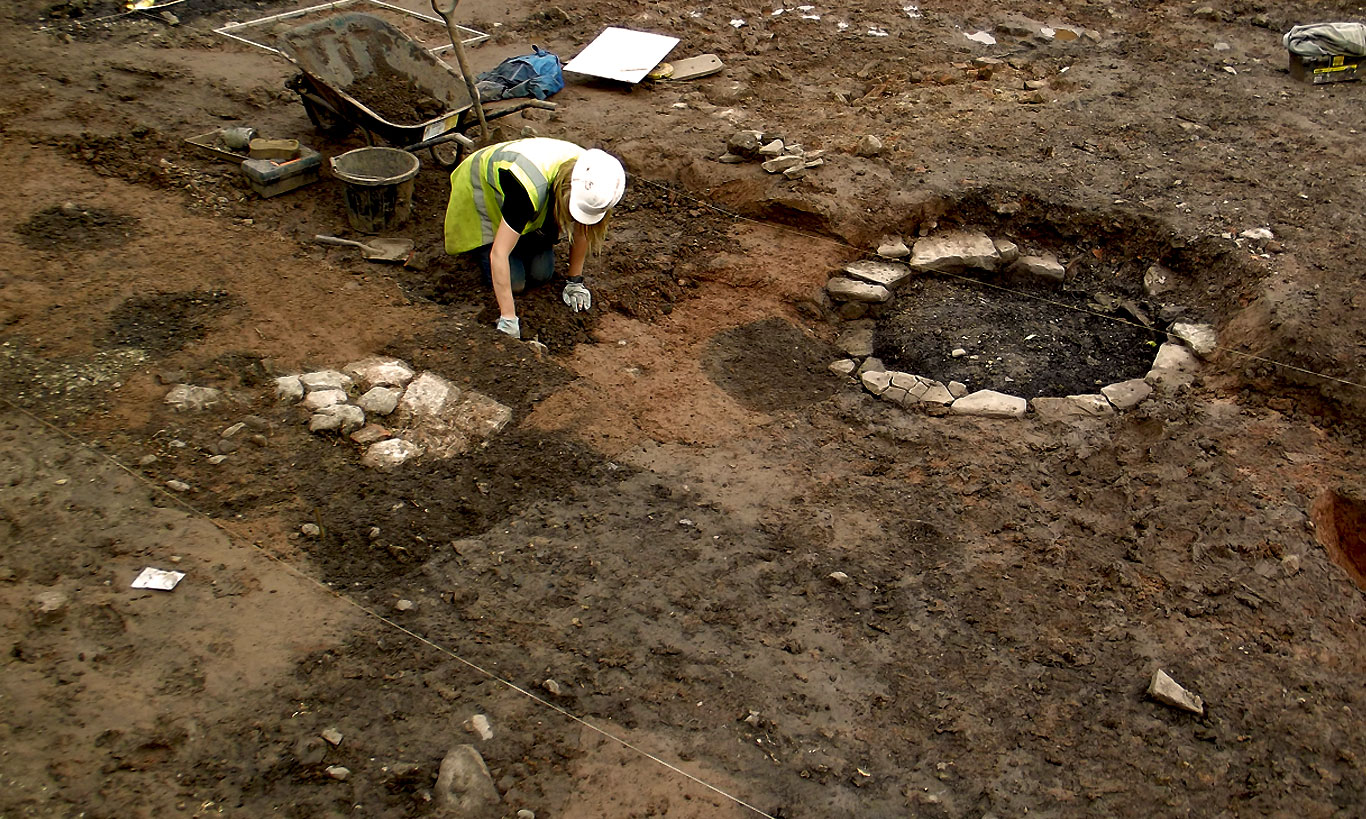
During the soil stripping of part of the Cwmbargoed Mountain, north of Gelligaer Common, a large area of burning was identified beneath the peaty topsoil. Within this burnt area several worked pieces of flint were recovered, including one fine Mesolithic (8000BC-4000BC) flint core.
A small quantity of burnt bone was recovered from a slight depression but it is unclear whether this is the result of food waste or possibly from a cremation. A rim-sherd was recovered a short distance from the burnt area but is not thought to be related to burnt bone.
Measuring c6cm² the rim is steeply bevelled, with a short neck and rounded shoulder; the diameter can be estimated at approximately 200mm. The sherd is in extremely poor condition and the fabric is soft and very friable. The rim is believed to be prehistoric but further analysis and conservation is required before any definitive conclusions can be drawn regarding its origins.
The presence of an enclosure at Church Hill has been known for a long time. Because of the name, it was always though to be an early churchyard, and the nearly circular shape is often considered typical of pre-Norman church sites. However, a local resident Helen Grove, brought Roman pottery she had discovered on the site into the Glamorgan- Gwent Archaeological Trust, and the Trust reported the find to Cadw. The site became a Scheduled Ancient Monument at the beginning of 2008, and Cadw has funded work on a small excavation to find out more about it, and to see whether the track that ran over the enclosure had done any serious damage to the archaeology. The excavation was carried out by the Trust, students from Swansea University and members of the Royal Institution of South Wales.
Our excavations have shown that vehicles on the track have made ruts in the surface of the bank surrounding the enclosure, and stones have been added to it, probably to repair damage.
We have also discovered a wall outside the enclosure. This is probably part of a building, but we have not yet found any other walls belonging to it. A lot of tile has been found in this area, but the excavation has produced remarkably few finds for a Roman site.
This year's Open Day had the usual mix of stands manned by local heritage and conservation groups, children's activities, and living history. We held it on the second Saturday of National Archaeology Week, rather than on the first Saturday as we have in the past, so that the popular group of medieval archers and their families from Margam, Meibion y Ddraig (Sons of the Dragon) could attend. Fortunately the day was mostly fine although there were a few sharp showers, one of which put paid to frying at the Roman cookery demonstration when raindrops started spitting in the pan!
Besides prehistoric pottery making, cave painting, and dressing up in costumes provided by Swansea Museum and Meibion y Ddraig, the children's activities included a chance for them to try their hand at real archaeological techniques under expert supervision. A specially constructed excavation was available for them to dig up, record and interpret, and real Roman pottery, tile and bone was on hand from the Church Hill site for them to wash. Another innovation in the children's activities was a feedback form which was designed to make them and their parents aware of the different activities on offer, and will also allow us to assess their popularity by age group. Forms were given out and collected by a volunteer in medieval costume, who was also able to point visitors in the direction of the various stands and activities.
The HER was there for visitors to consult, as were our finds experts. Also represented were members of Swansea Metal Detecting Club, the Oystermouth Historical Association, Friends of Oystermouth Castle, the Neath-Tennant Canal, Gower AONB, the Gower Society, West Glamorgan Family History Group, West Glamorgan Archive Service, and South-west Wales Industrial Archaeology Society.
GGAT's HER Manager demonstrating the HER to the public
Children being taught how to excavate
The Roman cooking hearth with it's pots and pans at the Open Day
Two members of Meibion y Ddraig demonstrating fighting techniques
Archaeological Open Day: Swansea Museum, Victoria Road, Swansea
GGAT, in partnership with Swansea Museum, will be holding its annual Open Day on Saturday 19th July 2008 as part of its National Archaeology Week events program.
National Archaeology Week is an annual event organised nationally by the Council for British Archaeology and aims to give everyone the opportunity to learn about the heritage that is all around us by becoming involved in archaeology.
There will be hands-on activities suitable for all the family, and exhibitions from a wide range of local heritage groups. Trace your family tree, meet a re-enactment group of medieval bowmen, 'Mibion y Ddraig', taste Roman food, or join the young archaeologist club.
You can get your hands dirty making prehistoric-style pots, build a wattle and daub fence, or try your hand at prehistoric cave art and much more.
You can bring your mystery artefacts along for identification by our Finds Liaison Officers and experts from Swansea Museum at our Finds Roadshow. Talk with professional archaeologists about the archaeology within your community and view what archaeology exists is in your local area as well as learning more about the Historic Environment.
For more information on National Archaeology Week and other activities that will be happening across Wales this July, visit the CBA's National Archaeology Week websiteor email Sue@ggat.org.uk
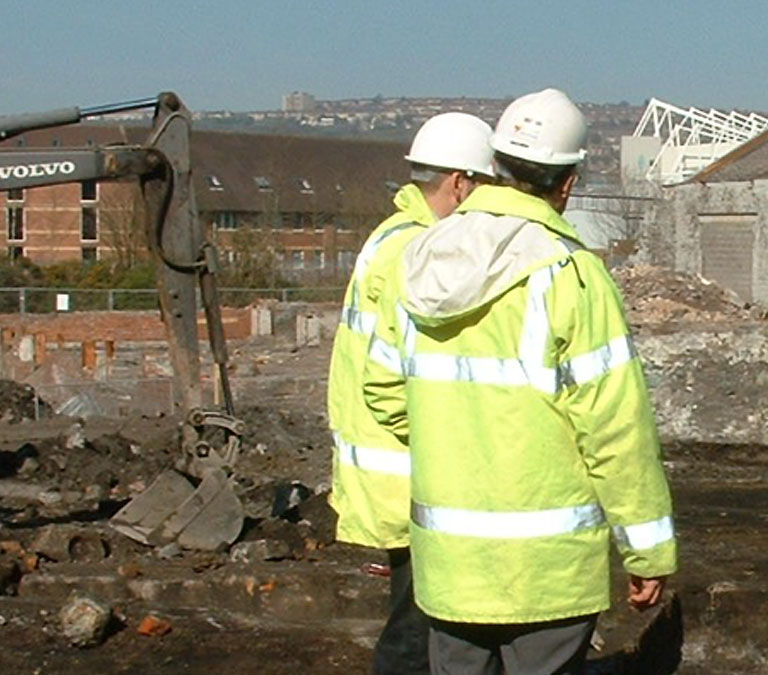
During the summer of 2007 work, carried out by Miller Argent (South Wales) Ltd, began on the reclamation of 367ha of derelict industrial land on the northern edge of Gelligaer and Merthyr Common at Ffos-y-fran, to the east of Merthyr Tydfil, South Wales. Ffos-y-fran has been the focus of intense industrial activity, primarily coal and iron ore extraction, for well over 250 years. Indeed, it was near here in 1759 that the Dowlais Ironworks, later to become the largest ironworks in the world, was first established to monopolise on the area's abundant mineral resources.
Ahead of reclamation the Glamorgan-Gwent Archaeological Trust has been given the opportunity to fully record the many industrial features that have survived at Ffos-y-fran. These range from 18th century patchwork mines, a well-preserved steam driven ironstone mine belonging to the early 19th century called the Soap Vein Pit, several mid-19th century ironstone and coal mines, tramroads, railways and the Dowlais Free Drainage System. The latter an extensive hand-dug network of leats and ponds from the early 19th century, which drained water from the upland moor at Ffos-y-fran for the Dowlais Ironworks. In addition to the industrial remains, a well preserved post-medieval agrarian settlement is being recorded, which overlooks the site of the former Dowlais Ironworks. It is likely, based on early cartographic evidence, that the two are related, the settlement possibly providing labour to the fledgling ironworks. Features of the settlement include at least four domestic buildings, a well, a complex of field systems and the poorly preserved remains of the 18th century Cardiff to Dowlais road.
The reclamation process will entail the extraction of coal by opencast methods. Hitherto, the focus has been on the archaeological features found on or close to the existing ground surface but the prospect of opencast will provide the exciting opportunity of recording subterranean industrial features previously inaccessible until now. The archaeological programme is expected to continue well into 2008.
Excavations on the site of David Evans store, Swansea
The site of the David Evans store on Princess Way is being redeveloped as part of the redesign of Swansea city centre. When the store's basement was dug in the 1960s, one of the defensive ditches for the castle was found by Bernard Morris, although there was no time then to examine it properly. The new development has given the opportunity to find out more about what was happening on this site in the Middle Ages, and GGAT has been commissioned by Thurleigh Estates to carry out an excavation before building work starts.
The castle buildings still standing today are only a small part of the castle in the Middle Ages - its outer bailey extended over what is now Castle Square and both sides of Castle Street and Worcester Place, as far north as College Street and Welcome Lane. The ditch on the David Evans site is the one that defended the western side of the outer bailey. The work that has been done so far shows that it was 10.3m wide and may have been about 3.5m deep.
How much survives on the site depends on how much damage has been done by the cellars of the buildings put up in Victorian times. We know from documents that the bailey contained not only castle buildings, but also houses belonging to the townspeople. We also hope to find more buildings of the medieval and post-medieval town west of the ditch.
Archaeologist recording inside the David Evans building prior to demolition
Archaeologists recording some of the excavated features at the site
An archaeologist excavating a post-medieval feature at the former David Evans store
Following the discovery of the Kenfig footprints and our first report on them, further bad weather removed even more sand from the beach and it is now clear that that there at least two peat shelves on Kenfig Sands. The lower shelf is the one where the human footprints are. This peat was laid down over clay and can now be seen eroding out of the middle and lower part of the beach. Our second visit discovered two more groups of footprints in it, further along the beach in the Margam direction, and also a hoofprint impressed in the underlying clay. These footprints are now being studied by a specialist team from Liverpool John Moores University, who have also taken samples of the peat from both shelves. These samples will enable them to obtain radiocarbon dates, and to look at the pollen that was trapped when the peat was laid down. This will show what plants were growing in the area at the time and will help us to reconstruct the ecology.
Although the area between the visible sections of the upper and lower peat shelves was covered in sand and shingle brought in by the sea, we could tell that the upper shelf was something different because the peat had been laid down over sand. This suggests that water running off from the land may have been blocked by sand dunes causing a marsh to develop behind them, like conditions today at Jersey Marine or Oxwich. No human prints have been recognised yet on this upper peat shelf, but there are areas that appear to have been trampled by cattle. They look very similar to areas on the Severn Levels east of Newport, at Goldcliff, where cattle trampling surrounds a wooden building on a low peat hummock on the foreshore of the Levels.
Although we could not see any similar buildings where the trampling was at Kenfig, we saw a small part of what looked like a wooden fence, and it is possible there were other wooden structures covered by beach deposits. The trampled are looks just like what you would expect in a modern farmyard, except that the mud has solidified and there is of course no smell. If the upper peat shelf remains exposed for any length of time, we hope to take more samples of the peat from this area to look for microscopic remains of plants and insects associated with the animals. Deposits from the building at Goldcliff produced the remains of cattle lice, confirming what the prints said, and we hope we may be able to get similar results from Kenfig.
Features on upper peat shelf marked in pink, features on lower peat shelf in green
The footprints at Kenfig were discovered by Steve Maitland-Thomas when walking along the foreshore, below the high tide mark, between Gwely'r Misgl and Sker Point. He invited staff from the Glamorgan-Gwent Archaeological Trust and National Museum Wales to come and examine them.
They had been made in a layer of peat which was deposited when sea levels were lower than they are today. The ground was permanently waterlogged, so when plants died they did not decay but built up as a peat bog. We do not know when this was, because the peat has not been dated. However, there is a peat shelf in a similar position on the foreshore at Brynmill, Swansea, and a brushwood trackway laid across it has been dated by radiocarbon to a period roughly between the beginning of the 1st century BC to the beginning of the 2nd century AD. It is not unlikely that the Kenfig peat shelf was formed at about the same time.
The footprints were made by at least one person, and probably more than one, walking across the peat bog when it and the clay underneath were soft enough to take prints. This tells us that they cannot have been made recently, as both the peat and clay are now too firm. Although we know that the prints were made after the peat had started to form, we can't tell how much after. The prints appeared towards what seems to be the bottom of the bog, but we don't know whether they were made when the peat first formed, or whether some of the original peat had eroded away before the prints were made. Most of the prints which have been seen so far do not look as though they were made by bare feet because they are the wrong shape, so the people making them were either wearing shoes of some sort, or had wrapped their feet up to keep them dry. The prints were clear enough to be easily made out in five places, and photographs have been taken of each of these prints or groups of prints.
The conditions which exposed the footprints are part of a naturally recurring cycle. Sand and other sediment is picked up by waves from the bottom of the sea when they have a lot of energy given to them by storms and high winds. When conditions are quieter and the waves have less energy, the sand and sediment drop out of the water and are redeposited on the foreshore. This will eventually cover the footprints up again. When the peats are exposed, their surface gets eroded by the waves, but when they are covered up they are protected from erosion. Eventually, all the peat will be lost from Kenfig, and the footprints along with it.
Archaeologists from the Glamorgan-Gwent Archaeological Trust have been working for Environment Agency Wales during work on the flood defences of Caerleon. Whilst monitoring the works, the archaeologists found timbers protruding from the river bank, which are thought to be part of a post-medieval bridge crossing the River Usk. The timbers are on the south-east bank of the River Usk, as it meanders past the town, and are on the line of a bridge illustrated on old maps of the town, but which was destroyed and eventually replaced by the current stone bridge, which was built by 1812.
After the initial discovery, the timbers were carefully reburied until Environment Agency Wales' engineers could ensure that the river bank was stable enough to allow the archaeologists safe access to study the structure further. Now the team are working quickly, in between the high tides, to fully uncover the bridge remains and record them. They will also be taking samples of the main timbers for dendrochronological (tree ring) dating, to determine when the bridge was built.
The main find consists of one pier of the bridge, which consists of a sole or base plate made from a single piece of oak approximately 7m long. There is evidence that an attempt was later made to strengthen the bridge, with two cross-timbers attached to the sole plate with iron spikes, and two rows of cobbles and a further timber placed on the river side of the sole plate. The sole plate is pierced by three large mortice holes, into which the tenons of three upright timbers that supported the road way would have fitted.
An etching of the timber bridge from Chepstow, published in 1801, shows a similar method of construction, although in this instance the sole plate supports five upright timbers, rather than three like the Caerleon bridge. Archaeologists from the Trust were involved in excavating and recording a medieval timber bridge at Monmouth in 1988 for the National Rivers Authority (the predecessor of the Environment Agency) and have noted the similarities in the construction techniques used in both bridges. These similarities between the two bridges probably demonstrate the conservative nature of engineers in the medieval and post-medieval periods, when a successful bridge design was unlikely to be greatly altered from one structure to the next.
Although we don't yet know how old the bridge is, we know that it was damaged in 1772. In his 'An Historical Tour of Monmouthshire' the Rev William Coxe retells the story of a heavily pregnant Mrs Williams, who was crossing the bridge on 29th October 1772, when a large part of it was swept away by the force of the current. Fortunately, she was able to hold onto the bridge fragment and was carried downstream, to be finally rescued by sailors near the mouth of the River Usk and returned by boat to Newport.
View to the southeast showing bridge pier and adjacent riverbank
Bridge timbers originally exposed by archaeologists
Mortise hole in sole-plate
Engraving by R.Colt Hoare of Caerleon Bridge. Published 1801 by Cadell and Davis
Archaeological work on a residential development between Monnow Street and the River Monnow has revealed evidence for pits and drainage channels in what appears to have been open ground to the rear of medieval buildings fronting Monnow Street, a suburb of the ancient town. Examination of the rich and varied contents of these pits will prove invaluable for increasing our knowledge about the lives of the medieval occupants of Monmouth.
The southwest part of the site contained at least eight pits of varying shapes and sizes. These contained scattered slag, animal bone, occasional sherds of medieval pottery and several objects of copper alloy.
The purpose of these pits may initially have been to extract clay or gravel, but subsequently they were used for rubbish, nightsoil and industrial debris. It is clear than some, if not all, served as cesspits, and were probably emptied on a regular basis for spreading on the surrounding fields.
Among the pottery were substantial parts of a tripod pitcher from north Wiltshire, of 12th century type, jugs from Ham Green, Bristol and local products known as Monnow Valley ware, typified by bands of repeated decoration applied with a wheel. Items of copper alloy included buckles, an annular brooch and other dress fittings, with scrap fragments suggesting metalworking in the vicinity. A pit had also been used for the deposition of butchery waste; a large group of horn-cores had been thrown into the bottom.
Following the excavation this important material will be carefully studied in order to understand more fully the origins and development of this major medieval town on the Welsh border. This work will be published in due course.
The Glamorgan-Gwent Archaeological Trust is indebted to Galliard Homes Ltd and their agents PSP Consultants, for ensuring the success of this project. Thanks are also due to Stacey Construction Ltd and their subcontractors for their assistance and co-operation on site.